
5 Things to Verify Before Buying a Builder Floor in Gurgaon
The real estate landscape in Gurgaon has undergone a massive paradigm shift over the last few years. While high-rise condominiums used to dominate the skyline, a new class of discerning home buyers is moving toward low-density, highly private, independent luxury builder floors. The allure is undeniable: villa-style privacy, zero shared walls with neighbors, dedicated stilt parking bays, private elevator access, and exclusive perks like dedicated basement rooms or private terraces.
However, because independent floors sit on individual plot allocations, the legal, structural, and financial due diligence required is vastly different from buying a standard high-rise apartment. In a bustling market like Gurugram, a lack of verification can lead to costly delays or legal disputes.
To ensure your investment is safe, seamless, and completely future-proof, here is the ultimate 5-step checklist you must verify before signing on the dotted line.
1. Clear Land Titles and Chain of Ownership

Unlike a massive group housing society where a single corporate developer owns a vast master tract, builder floors are constructed on specific residential plots (ranging anywhere from a compact 129 sq. yds. to an expansive 1,000 sq. yds.). Often, these plots change hands multiple times or are developed via Collaboration Agreements between the original land owner and a luxury developer.
Before making a booking amount payment, your legal counsel must verify:
-
The Title Deed (Sale Deed): Confirm that the seller or developer has a clear, unencumbered right to the land.
-
The Collaboration Agreement: If a builder is constructing the property on someone else’s land, read this document carefully. It explicitly dictates the “Allocation Ratio”—stating exactly which floor levels belong to the builder (to sell to you) and which floors stay with the original owner.
-
The Chain of Documents: Ensure you have access to a clear, uninterrupted chain of title documents dating back at least 30 years to guarantee no third-party claims exist.
2. RERA Registration and Haryana Building Code Approvals

Never assume a low-rise building is exempt from regulatory authorities. In Haryana, structural and legal compliance is tightly governed.
-
HRERA Compliance: Ensure the project is registered under the Haryana Real Estate Regulatory Authority (HRERA) if it meets registration criteria. A RERA number ensures that your money is kept in a dedicated escrow account and that the builder is legally bound to the committed possession timeline.
-
Sanctioned Building Plans: Under the Haryana Building Code, the maximum permissible layout for independent floors is typically restricted to Stilt + 4 Floors or Stilt + 3 Floors. You must verify that the building plan has been formally approved by the DTCP (Department of Town & Country Planning) or HSVP.
-
The Demarcation of “Exclusive Zones”: If you are buying a premium unit—such as a first floor with a private basement or a fourth floor with private terrace rights—ensure these specific allocations are officially drafted into the sanctioned architectural blueprint and the buyer agreement. Verbal promises of “exclusive roof access” hold zero legal weight.
3. Allocation of Stilt Parking and Lift Maintenance Rights
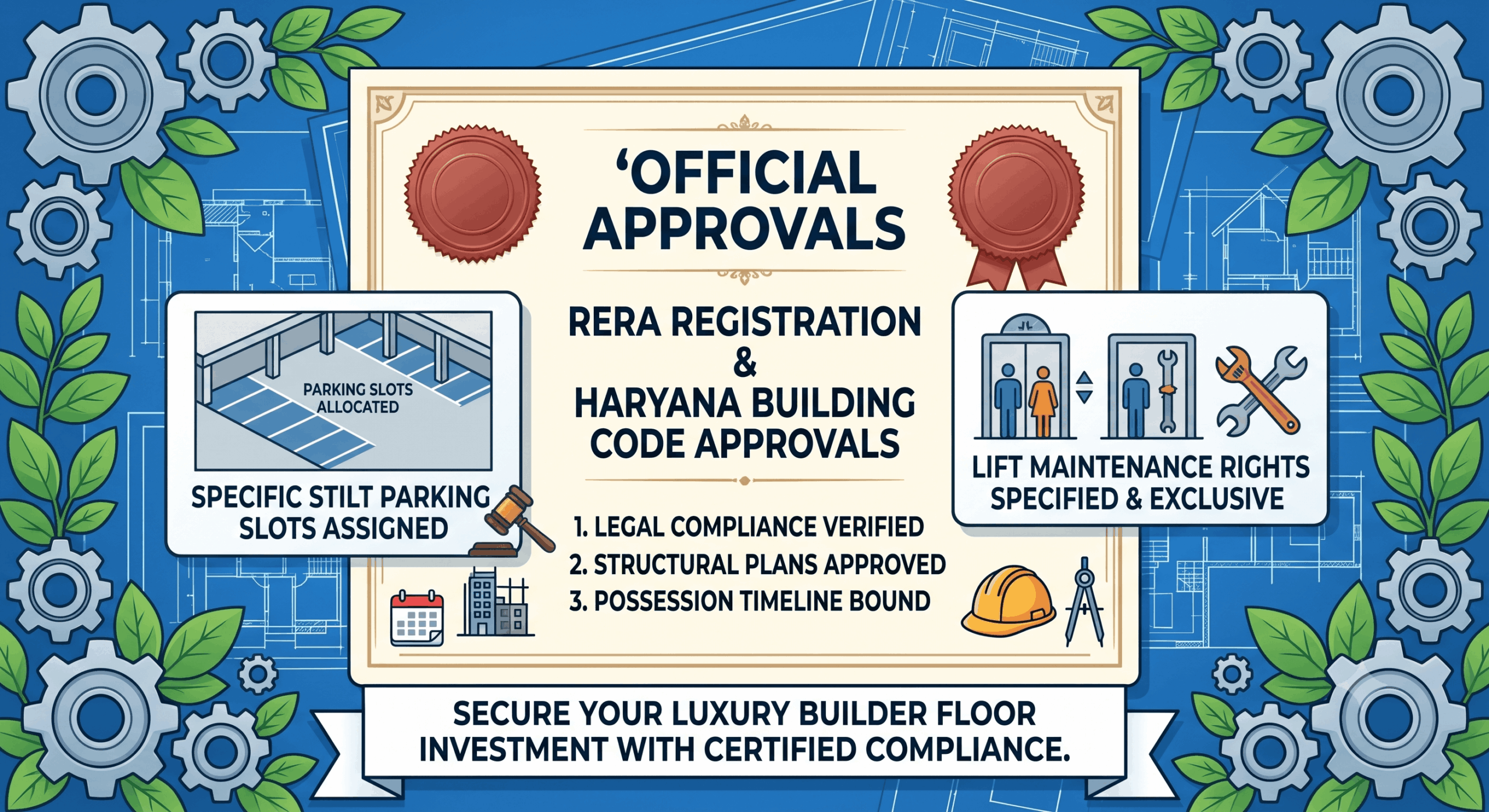
One of the most frequent points of friction in multi-family independent low-rise buildings revolves around shared infrastructure—specifically the stilt parking area and the elevator.
-
Marked Car Parking Bays: A luxury builder floor should ideally offer 2 to 3 covered stilt parking spaces per floor. Ensure your specific bays are clearly numbered and marked on the layout plan attached to your sale agreement.
-
Power Infrastructure for EV Charging: With the rapid adoption of electric vehicles, check if the stilt infrastructure includes dedicated electrical conduits running from your individual floor’s sub-meter down to your parking bay for an EV charging station.
-
Lift Ownership & Power Backup: The elevator is a lifeline in a four-story building. Verify that there is an explicit, legally binding clause in your maintenance agreement outlining the shared cost of lift electricity, AMC (Annual Maintenance Contract), and the power backup load. Ensure the builder provides at least a 5 KVA dedicated power backup load per floor to keep the lift, common lights, and your home’s heavy appliances running smoothly during a power outage.
4. Quality of Structural Construction and Material Specifications

High-rise buildings are subject to intense institutional oversight, but boutique independent floors are built by private developers. Therefore, assessing construction quality falls squarely on the buyer.
When touring an under-construction site or checking a builder’s past portfolio, inspect the following:
-
Damp-proofing and Waterproofing: Because many luxury floors feature highly desirable basement spaces (like 1/3rd or full basements for private offices and home theaters), check what type of waterproofing membranes and retaining wall architectures are being used. Substandard waterproofing can lead to severe structural dampness during monsoon seasons.
-
Acoustic Insulation (No Shared Walls): True luxury floors feature independent structural framing or double-brick walling between adjacent plots. Confirm that your living spaces are acoustically insulated so you do not hear ambient noise from the neighboring plot.
-
Internal Fitments: Walk through the mock-up layout or check the specification sheet for high-end benchmarks: 18mm premium imported marble, VRV/VRF central climate control infrastructure, and branded modular kitchens equipped with high-capacity chimneys and hobs.
5. The Micro-Market Ecosystem and Neighborhood Infrastructure

A luxury floor is only as good as the sector it is built in. Gurgaon features several distinct low-rise micro-markets, each offering a completely different lifestyle profile.
-
Established Gated Townships: Buying a builder floor inside an established master township (such as BPTP Amstoria in Sector 102, Rosewood City in Sector 49, or Emaar Emerald Hills/Marbella in Sectors 65 & 66) gives you the best of both worlds. You get the privacy of an independent floor along with the benefits of a gated community: 24/7 internal security patrolling, wide black-topped roads, manicured parks, and access to elite operational clubhouses.
-
Internal Revenue Roads vs. Secure Clusters: Ensure the specific lane your plot sits on is a secure, residential-only lane with no unauthorized commercial thoroughfare or village traffic intersecting it.
-
Proximity to Rapid Transit: Look for sectors situated along rapid growth corridors like the Golf Course Extension Road, Sohna Road, or the Dwarka Expressway. High-performing sectors offer seamless connectivity to the IGI Airport, corporate boardrooms, and premium high-street retail zones (like Worldmark or M3M 65th Avenue), guaranteeing excellent rental yields and rapid capital appreciation.
Summary Checklist for Buyers
| What to Verify | Documents / Proof to Request |
| Land Ownership | Clear Sale Deed & Registered Collaboration Agreement |
| Legal Sanction | Approved Layout Plans (Stilt + 3/4) & HRERA Number |
| Bonus Spaces | Legally documented Basement/Terrace allocation clauses |
| Parking & Utilities | Numbered stilt bays & 5 KVA (minimum) Power Backup load |
| Infrastructure | Position inside a gated township or secure residential pocket |
Final Thoughts
Investing in an independent luxury floor in Gurgaon is an exceptional move that offers unparalleled lifestyle freedom and a higher share of underlying land value than standard apartments. By checking off these five critical legal, structural, and local checkpoints, you can protect your capital and move into your dream home with absolute peace of mind.
Looking for legally verified, premium independent builder floors in Gurgaon’s top sectors? Browse our latest handpicked listings at BuilderFloorinGurgaon.com or connect with our micro-market experts today for a private site tour.