
High-Rise vs Builder Floor: Land Share Appreciation in Gurgaon
When making a multi-crore real estate investment in Gurgaon, buyers usually arrive at a critical fork in the road: Do they buy a luxury apartment in a sprawling high-rise condominium, or do they opt for an independent builder floor in a low-rise layout?
High-rise complexes attract many with their glitzy clubhouses, massive swimming pools, and community living. But seasoned real estate investors and affluent Non-Resident Indians (NRIs) are quietly shifting their capital toward premium independent builder floors.
The reason isn’t just about a preference for privacy or larger carpet areas. It is driven by a cold, mathematical reality in wealth creation: The Undivided Share of Land (UDS). In Gurgaon’s fast-maturing market, land-backed assets appreciate fundamentally faster and more securely than air-space units. Here is a deep dive into the asset mechanics of why builder floors win the long-term appreciation game.
1. Understanding Asset Composition: Brick vs. Dirt
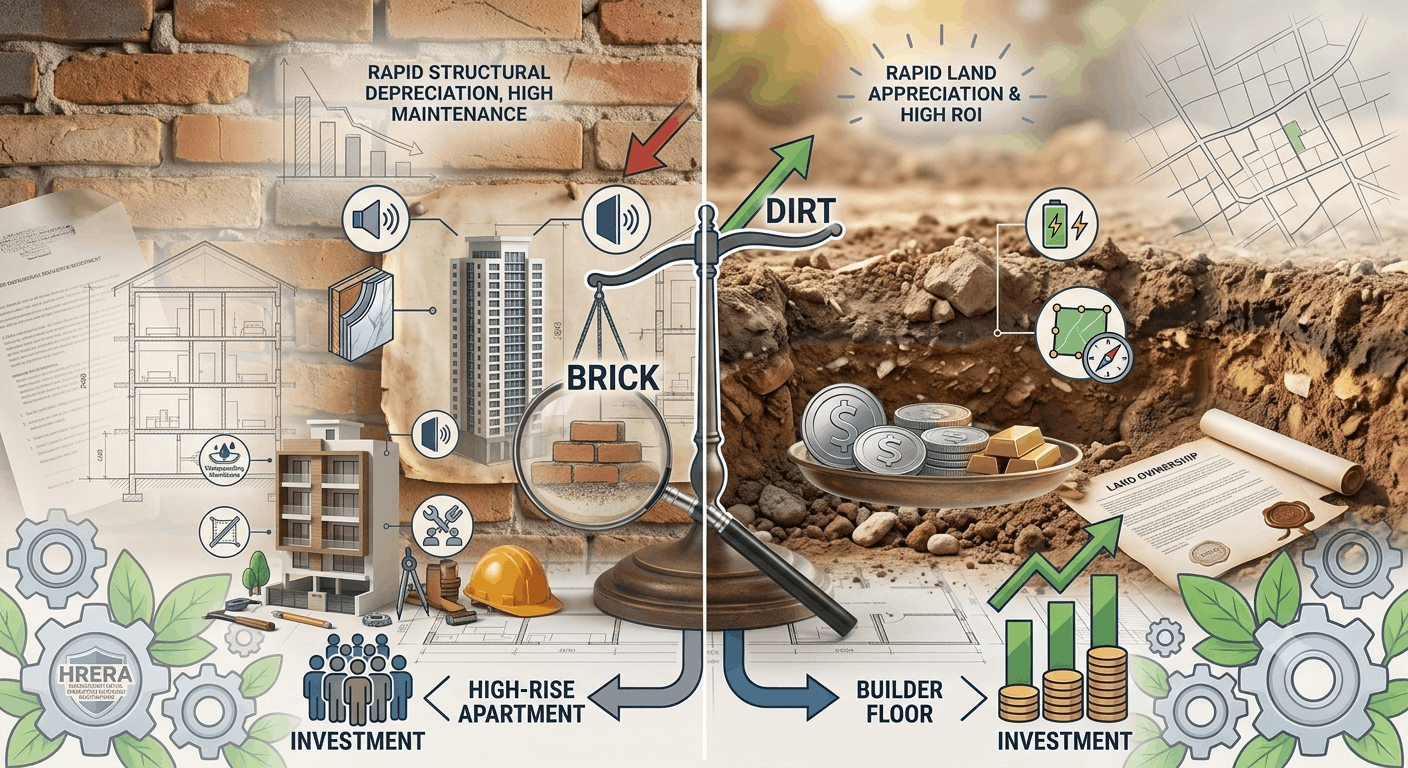
Every real estate asset consists of two components: the structure (the building materials, concrete, and interior fitments) and the underlying land it sits on.
-
The Structure Depreciates: From the day construction finishes, concrete aging begins. Paint fades, plumbing degrades, and elevators wear down.
-
The Land Appreciates: Land is completely finite. In highly coveted zones like Golf Course Extension Road or DLF Phases 1–5, they are not making any more land. The scarcity drives up its worth.
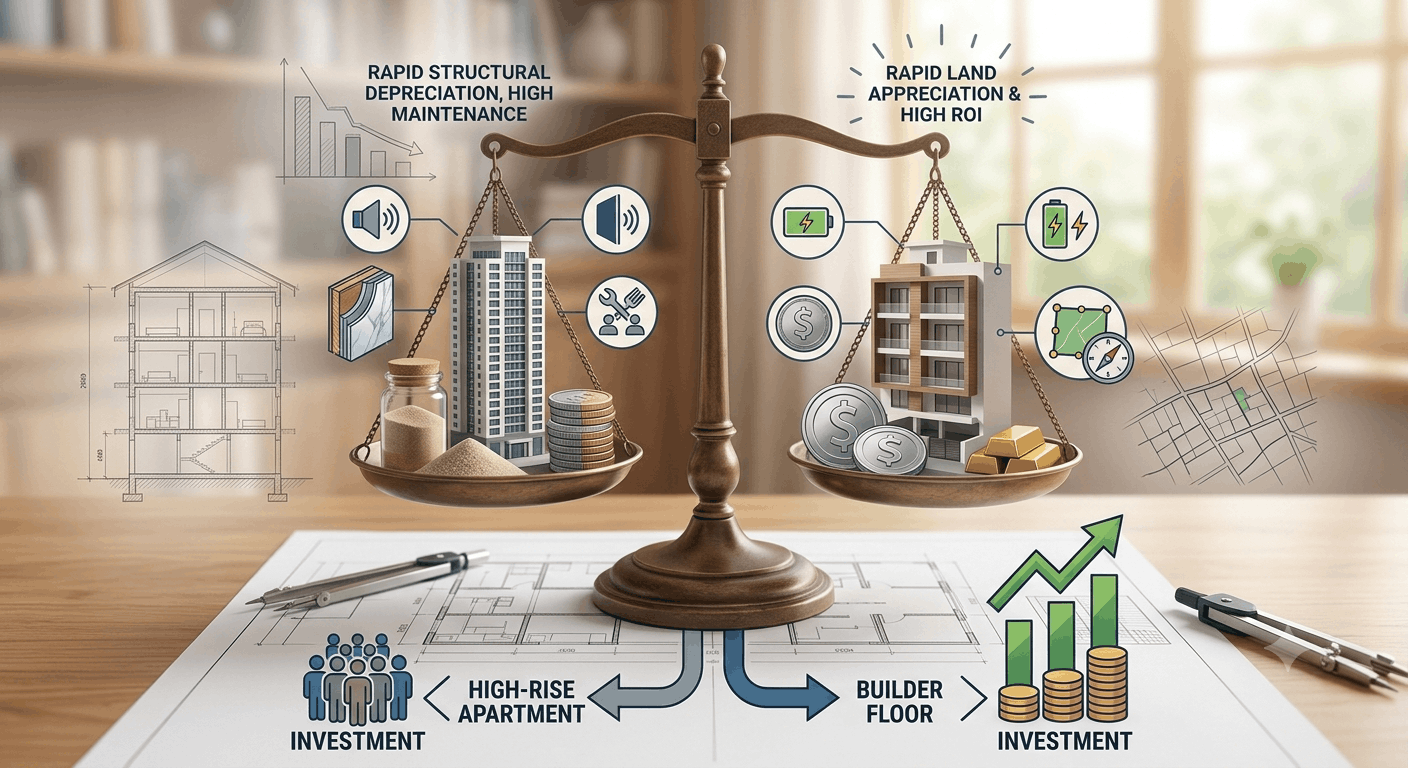
In a standard high-rise complex, a 40-story tower might hold 160 families on a relatively small footprint. When you buy that apartment, your mathematical land share fraction is highly diluted. Essentially, 80% to 90% of your purchase price goes toward paying for the developer’s brand, the structural concrete, and the shared lifestyle amenities.
In a luxury builder floor, the building is strictly limited to Stilt + 4 levels. This means a massive residential plot—say 353, 505, or 585 square yards—is divided among just 4 independent owners. A massive chunk (often 60% to 70%) of your purchase price is going directly into securing real, physical land in Gurgaon.
2. The Power of Undivided Ground Share (UDS)
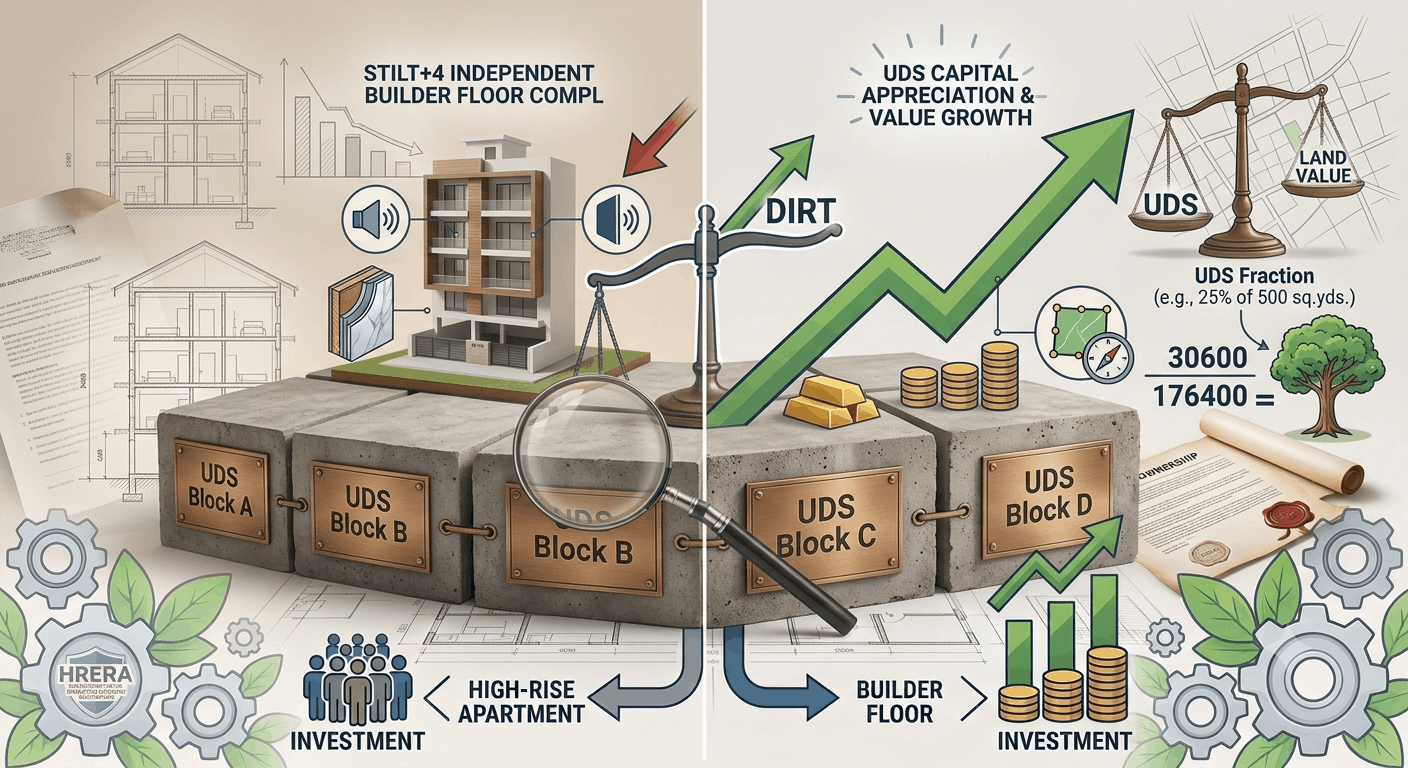
Let’s look at the numbers. Consider a premium plot size of 500 square yards in an established gated community in Sector 57 or Sector 63A.
When you invest in a builder floor on this plot, your deed legally assigns you a massive 125 square yards of absolute ground share.
If land rates in that sector climb due to an infrastructure push, your individual net worth climbs instantly alongside it. If a high-rise apartment owner wants to calculate their land share under a massive cluster layout, their actual physical land entitlement often rounds down to single-digit square yards. You own the airspace inside your walls, but very little of the earth beneath it.
3. The Re-Sale Liquidity and Freedom Factor
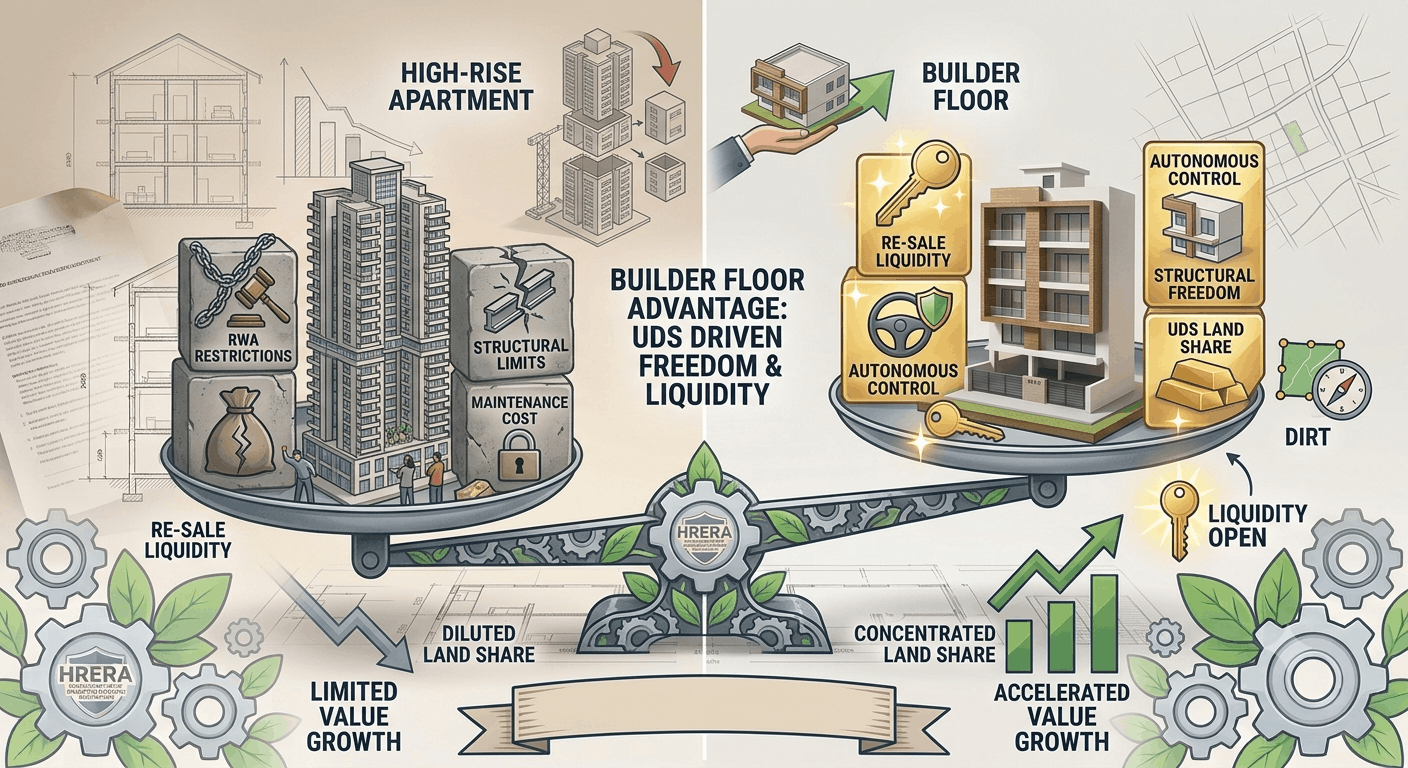
Because high-rises are dictated by centralized Residential Welfare Associations (RWAs) or complex corporate builders, an individual owner has zero control over structural modifications.
With an independent floor asset, you share control with just three other like-minded families. Historically, when low-rise plots in premium locations age (around the 20 to 25-year mark), the group of floor owners can easily enter a fresh joint-venture collaboration with a premium developer to tear down and rebuild a brand-new, ultra-modern luxury building at almost zero capital cost to themselves. Try coordinating a structural rebuild or developer collaboration with 800 flat owners in a aging high-rise tower—it is virtually impossible.
4. Maintenance Costs: The Hidden Yield Killer
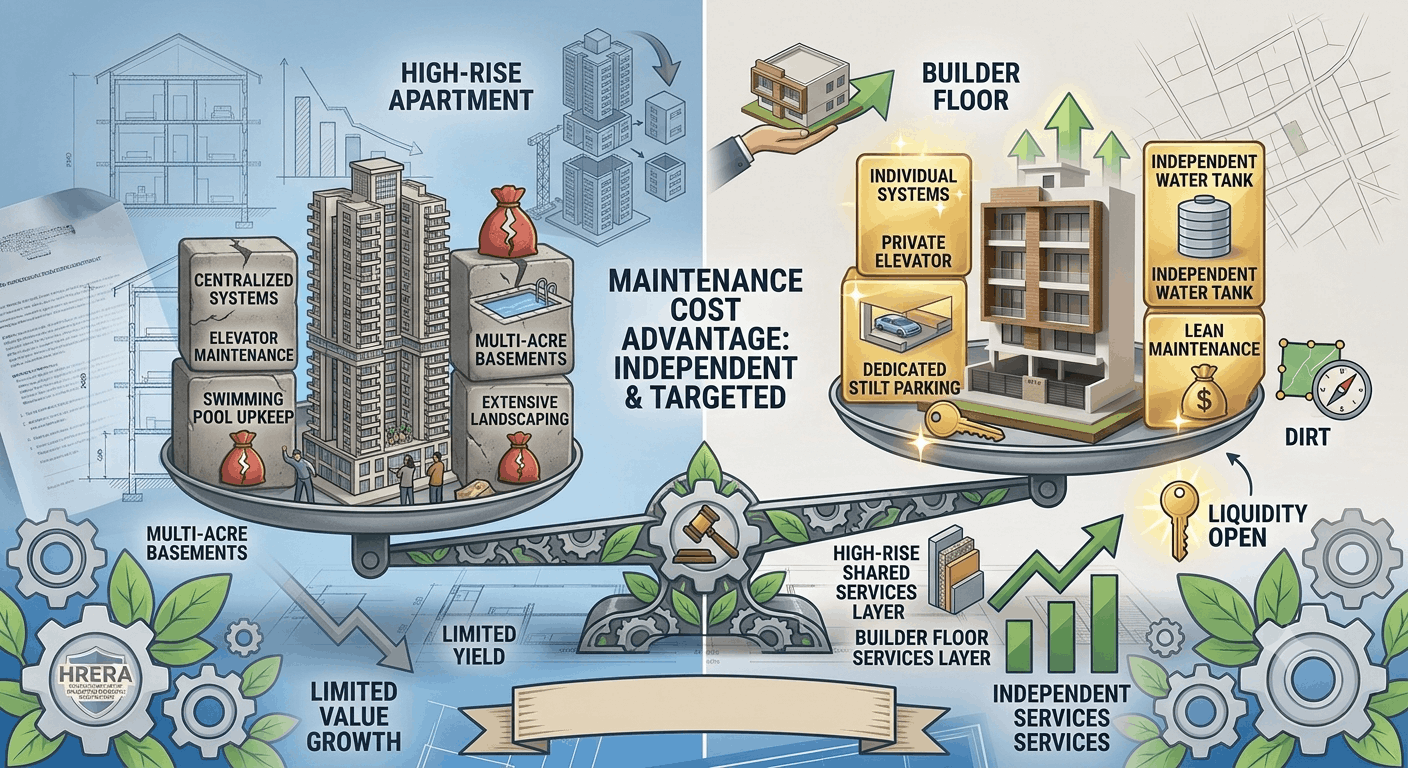
Appreciation isn’t just about the exit price; it’s about how much money you lose while holding the asset.
High-rise condominiums impose massive monthly maintenance overheads to upkeep multi-acre basements, heavy club swimming pools, centralized glass facades, and extensive landscape teams. It is common for premium high-rises in Gurgaon to charge anywhere from ₹10,000 to ₹25,000 per month in pure maintenance.
Independent builder floors feature highly localized systems: your own private elevator, dedicated stilt parkings, and independent water tanks. Maintenance expenses are exceptionally lean (typically floating between ₹2,000 to ₹5,000 a month). Over a 7 to 10-year holding period, this difference keeps lakhs of rupees in your bank account, directly inflating your net investment yield.
High-Rise vs. Builder Floor Investment Matrix
| Metric | High-Rise Apartment | Luxury Builder Floor |
| Asset Composition | Mostly Structure & Amenities | Heavy Land Value (60-70% of cost) |
| Undivided Land Share (UDS) | Deeply Diluted | High & Significant (25% per floor) |
| Appreciation Engine | Developer Brand & Trend-led | Land Scarcity & Location Driven |
| Monthly Holding Cost | High (₹10,000 – ₹25,000+) | Low (₹2,000 – ₹5,000) |
| Long-Term Control | Dependent on Central RWA | Autonomous (Shared by 4 owners) |
Conclusion: Secure the Base
If your goal is immediate access to resort-style Olympic pools and a high-density community vibe, a high-rise flat fits the bill.
But if you are deploying capital into Gurgaon real estate for multi-generational wealth, asset protection, and rapid compounding, land is king. Investing in an independent builder floor allows you to own premium, high-demand square footage in the heart of India’s millennial city while locking down a massive, defensible share of the physical land beneath it.
Ready to allocate your wealth into legally vetted, high-UDS assets? Explore premium independent builder floors ranging from 353 to 758 sq. yds. across Gurgaon’s top gated sectors at BuilderFloorinGurgaon.com. Connect with our investment consultants today for a detailed land-value breakdown comparison.